The signal.
- Quantum computing will be an important dual-use technology to help defend a country's sovereignty.
- Capital is the most important resource driving the quantum industry. Without the investment democracies cannot develop the technology into valuable defence applications.
Defence spending has become a major concern in the minds of government and the public. As the global order shifts from the post-Cold War assumptions of openness, integration and globalisation towards a more fragmented, protectionist and security-conscious landscape, western governments are making decisions about where to focus their R&D spend. Dual-use technologies – technologies with both civilian and defence purposes – are understandably becoming areas of focus for investment.

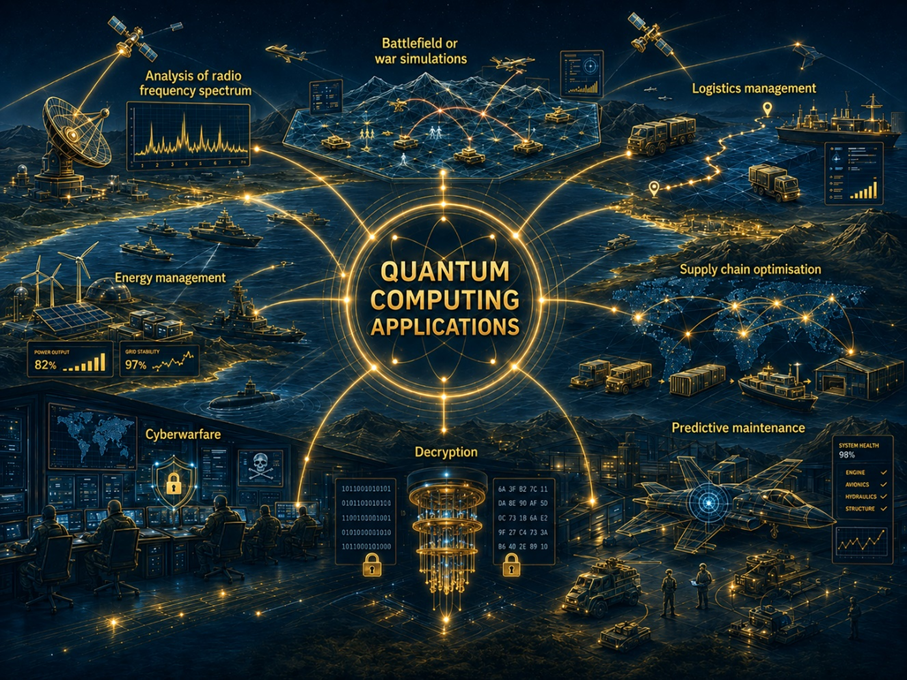
Quantum technology includes sensors, communications and computing, which are all important in defensive applications. Quantum sensors have many compelling use cases such as quantum inertial guidance, under-water/ground mapping and ghost imaging. Here we shall focus on quantum computing, which will be an important disruptive defensive technology. Decrypting sensitive information, discovering better materials and chemicals, and improving logistics through better resource allocation, workflows and routing are just some of its potential defensive uses.
" The industry is still in its infancy, so it is arguable that the winners are being prematurely identified by a wave of public and private spending. "
The quantum computing industry is maturing and moving away from laboratory demonstration into industrialised systems engineering. In the past year there has been a surge in listings and raises by newly vertically integrated companies, with governments lining up to be major investors. But the industry is still in its infancy, so it is arguable that the winners are being prematurely identified by this wave of public and private spending. But this observation highlights that capital, sovereignty, and technology, in that order, are the important drivers of the industry right now.
Capital
Capital is the immediate constraint shaping the quantum industry. Without sustained funding, the engineering required to turn quantum computing into a useful capability cannot be delivered. The recent IPOs, listings and fundraising by companies such as Quantinuum (2026 IPO: $1.68bn), PsiQuantum (2025 Series E raise: $1.0bn), and IonQ (2025 equity raises: $372.6m), and plans by IQM to raise over $146m through a 2026 PIPE financing, all support the view that capital is now shaping the sector.
Sovereignty
Sovereignty follows closely behind capital. Sovereignty is about having the capability to defend against others using the disruptive application of quantum computing. Quantum computers depend on access to bespoke hardware, control systems, cryogenics, fabrication, software and specialist skills. Due to the dual-use nature of quantum, countries are increasingly treating quantum computing as something to develop, protect and anchor domestically. But today, no single democracy can realistically fund or support the industry by itself. This means sovereignty is really about a country having access to the critical capabilities and integrating critical supply chains with allied countries. However, this is still a compromise over what sovereignty traditionally means, and this situation presents opportunities to investors and entrepreneurs.
Technology
Today quantum computing is still emerging, but it is already strategically important. This is because the direction of travel is clear – building a useful quantum computer is mostly an engineering challenge rather than a scientific problem. The challenges are mostly around scaling and controlling the qubits. One of the largest capital-hungry items needed by the industry is building new foundries that manufacture the qubit hardware. The costs may well be akin to the cost of making a state-of-the-art semiconductor foundry. Also, the hardware needs a middleware layer that runs the quantum hardware to perform fault-tolerant computations from useful quantum algorithms. The middleware layer of the architectural stack is composed of control, quantum error correction, logical qubits and operations, fault-tolerant orchestration and compilation, and logic stacks. This middleware layer demands the use of expensive classical high-performance computing and artificial intelligence (HPC-AI). Finally, the useful quantum algorithms needed to run on these quantum computers are yet to be properly explored. Until we have a functioning quantum computer, it will be difficult to generate the truly disruptive applications that will further drive the industry into commercial usefulness.

Conclusion
Knowing the relative importance of capital, sovereignty and technology in the quantum industry, a key question emerges. For any organisation, whether it is a company or a country, the critical question is not "when will quantum computing be useful?". It is "which capabilities do we degrade or lose if we wait and do nothing?". In peacetime, that may be a question of competitiveness, investment and industrial strategy. In an age of global conflict, it becomes a question of resilience, sovereignty and defence. Quantum computing is a dual-use technology and should be viewed as a strategic defensive capability before its offensive implications become impossible to ignore.
About Orbsight
Orbsight helps organisations separate the true signal from the hype while preparing for the transition toward useful quantum computing.
Drawing on experience across quantum device design and manufacture, miniaturised instrumentation, quantum error correction and deep tech commercialisation, Orbsight connects research, industry and investment with clear-eyed insight, technical credibility and a focus on real progress over hype. Orbsight provides services that include:
- Quantum architecture and manufacturing advisory
- Fundraising and investment strategy
- Quantum readiness assessments
- Integration strategies
- Ecosystem and partnership insight
For quantum computing companies
Do not ignore the dual-use potential of quantum computing and formulate suitable strategies for your company.
For private investors
Identify the organisations that can industrialise their technology.
For government
Identify the vital elements of the quantum computing ecosystem. Invest in those that create strategic advantage and mitigate critical dependencies or vulnerabilities.
Next move
Bring clarity to your next quantum computing decision. Whether you need to understand, invest, partner, build, integrate, communicate or wait, Orbsight will help turn that uncertainty into a practical route forward.
info@orbsight.io | orbsight.io
Note: Images were generated by OpenAI ChatGPT using the author's photographs and prompts.